
A meniscus injury can create uncertainty because symptoms vary widely between patients. Some people mainly notice discomfort with deep bending, while others experience swelling, stiffness, clicking, or difficulty returning to running and sport.
A well-planned meniscus tear recovery programme focuses on restoring knee function while respecting the type of injury and any medical restrictions.
For patients in Thane West, Maharashtra, understanding the stages of recovery can make it easier to avoid both unnecessary inactivity and premature return to demanding activities.
Not every meniscus injury follows the same pathway
The menisci are cartilage structures inside the knee that contribute to load distribution and joint stability.
The rehabilitation approach can differ depending on factors such as:
- Location of the tear
- Severity
- Symptoms
- Age
- Activity level
- Associated knee injuries
- Surgical treatment when performed
A patient treated conservatively may progress differently from someone recovering after meniscus repair.
Medical instructions following surgery are especially important because certain movements or loading levels may initially be restricted.
Early rehabilitation focuses on knee control
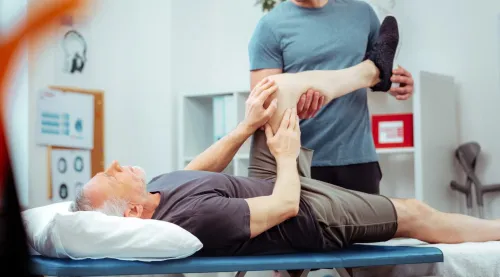
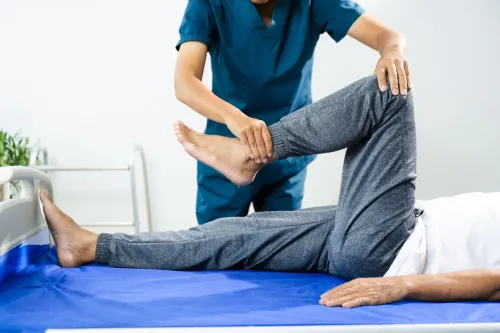
When appropriate, initial physiotherapy may work on swelling, comfortable movement, and muscle activation.
The quadriceps can lose strength quickly when the knee is painful or swollen.
Early exercises may therefore focus on restoring muscle activation without excessively loading irritated structures.
Walking quality is another useful indicator.
Patients sometimes continue limping even after discomfort decreases, which can affect movement elsewhere in the lower limb.
Strengthening needs gradual progression
As the knee becomes more tolerant, strengthening can progress beyond basic exercises.
Depending on the patient's condition, treatment may include:
- Sit-to-stand exercises
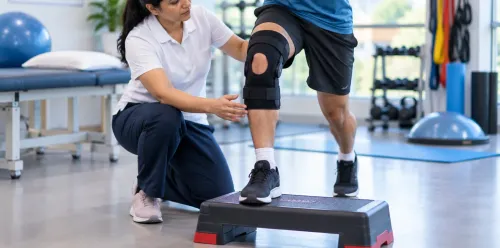
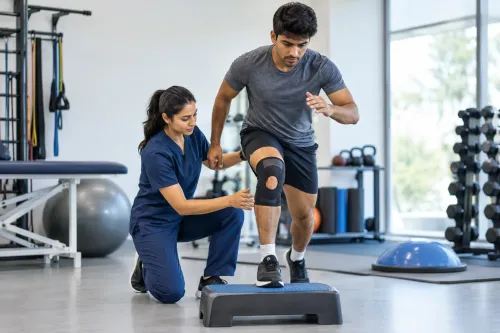
- Step training
- Squats within suitable ranges
- Hip strengthening
- Calf strengthening
- Single-leg control
- Resistance exercises
Rather than adding difficulty simply because time has passed, progression should reflect how well the knee handles the current workload.
Swelling provides useful feedback
One way to evaluate activity tolerance is to observe how the knee responds afterward.
Significant swelling after exercise can indicate that the current load needs adjustment.
This does not always mean that exercise should stop completely.
Instead, the amount, intensity, range, or frequency of activity may need modification.
A physiotherapist can help determine which changes allow continued progression while keeping symptoms manageable.
Returning to running needs preparation
Running creates repeated impact and requires adequate lower-limb control.
Before introducing it, rehabilitation may need to establish sufficient knee movement, strength, balance, and walking tolerance.
Once running begins, volume can be increased gradually.
Patients hoping to return to sport may later require jumping, landing, agility, and change-of-direction training.
At N V Physiotherapy clinic, rehabilitation can be adapted to the patient's meniscus condition, treatment history, activity level, and intended goals.
Common mistakes can slow progress
Several behaviours can make recovery unnecessarily difficult.
These include suddenly returning to full training, avoiding all knee movement because of fear, repeatedly testing painful deep bends, and focusing only on the knee while ignoring hip and lower-limb strength.
Another common mistake is stopping rehabilitation as soon as basic daily activities become comfortable.
Walking without pain is valuable progress, but an athlete may still be far from ready for running, jumping, and competitive movement.
Recovery should match the life you want to return to
A patient's rehabilitation goals should influence the later stages of treatment.
Someone who mainly wants comfortable daily mobility has different physical requirements from a badminton player, runner, or regular gym participant.
Meniscus rehabilitation should therefore progress from basic knee recovery toward the specific strength and movement demands that matter to the individual.
The goal is not simply to make the knee feel quieter. It is to rebuild the mobility, strength, control, and load tolerance required for confident everyday activity.
Keywords