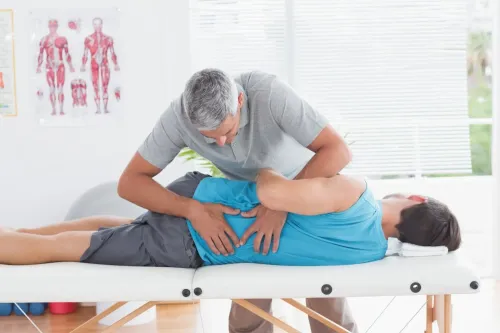

A stiff neck can mean anything from short-lived muscle guarding after an awkward night’s sleep to irritation around a nerve or cervical joint. You will learn how to compare common causes, recognise symptoms that need urgent medical assessment, and decide when a physiotherapy evaluation is a sensible next step.
Key takeaways
- Seek urgent care for neck stiffness with weakness, fever, severe headache, or injury.
- Book an assessment when restricted movement persists or disrupts sleep and daily tasks.
- A physiotherapy plan may combine movement exercises, hands-on treatment, and home care.
- Change the plan if pain worsens, movement stalls, or new symptoms appear.
What Neck Stiffness Feels Like and What May Be Causing It
True neck stiffness means movement itself is reduced, not just that the area feels sore. You may notice reduced neck rotation, difficulty looking up or down, pain when turning in bed, or guarding that limits shoulder or arm movement.
| Cause | Clues | What it suggests |
|---|---|---|
| Prolonged screen posture or awkward sleep | Local soreness and reduced range of motion | Mechanical stiffness |
| Muscle strain | Tenderness after lifting, exercise, or sudden movement | Irritated muscle |
| Cervical joint irritation | One direction hurts much more than others | Local joint involvement |
| Whiplash | Symptoms after a crash, altered coordination, headache, or dizziness | Needs separate assessment |
| Disc-related nerve irritation | Arm pain, pins and needles, numbness, or weakness | Possible nerve-root involvement |
| Inflammatory or systemic illness | Severe unremitting pain, fever, weight loss, cancer history, or immunosuppression | Prompt medical review |
After whiplash, movement coordination can change even when the main complaint is stiffness. Arm symptoms point away from simple muscle tightness and deserve clinical assessment.
No single perfect posture protects your neck all day. Change position, reduce prolonged aggravating loads, and gradually rebuild movement instead of holding your head rigidly.
Seek urgent medical assessment for stiffness after a significant fall or crash, fever, sudden severe headache, confusion, fainting, new weakness or numbness, trouble walking, loss of bladder or bowel control, or difficulty speaking or swallowing.
When Neck Stiffness Needs Urgent Medical Assessment
Routine physiotherapy is the wrong first step after major trauma or when neck symptoms suggest infection, cancer, spinal-cord involvement, or a vascular emergency. These neck pain red flags need medical assessment.
1. Seek urgent assessment for neck stiffness after injury from a significant fall, road crash, or other forceful impact, especially when the neck hurts or is difficult to move.
2. Get prompt medical review for fever and stiff neck, severe unremitting pain, unexplained weight loss, a history of cancer, or immunosuppression. Confusion, fainting, or a sudden severe headache with neck pain requires urgent care.
3. New weakness or numbness, clumsy hands, loss of hand dexterity, trouble walking, balance changes, exaggerated reflexes, or loss of bladder or bowel control can indicate spinal-cord involvement. Pain radiating into an arm with progressive weakness needs medical reassessment, not routine treatment alone.
4. Call emergency services for sudden neck pain or headache after neck movement or trauma combined with facial droop, difficulty speaking, vision changes, limb weakness, severe imbalance, or rapidly worsening neurological signs. Cervical-artery dissection can cause these stroke-like symptoms. Difficulty speaking or swallowing also belongs in the emergency pathway.
While waiting for help, keep your neck in a comfortable position. Do not forcefully stretch, crack, or self-manipulate it. Fainting, confusion, or any rapidly worsening symptom should never be managed by driving yourself to an appointment.
When to Book a Physiotherapy Assessment
Book a physiotherapy assessment when restricted neck movement lasts beyond a few days, keeps returning, limits work or driving, disrupts sleep, or fails to improve with gentle movement and routine self-care. This is a practical guide for when to see a physiotherapist for neck pain without emergency warning signs.
- Movement remains limited after several days.
- Stiffness repeatedly returns.
- Turning your head affects driving, work, or daily tasks.
- Pain or stiffness interrupts sleep.
- Gentle movement and routine self-care produce no clear improvement.
Your first neck pain assessment should begin with a symptom history covering onset, any injury, aggravating activities, arm symptoms, headache, dizziness, and changes in function. The physiotherapist should examine active neck movement, posture, shoulder movement, and perform neurological screening of strength, sensation, and reflexes.
These findings help distinguish local mechanical stiffness from radicular pain, headache-associated neck pain, and movement-coordination problems after whiplash.
For uncomplicated neck pain without red flags, MRI for neck pain is not automatically necessary; clinicians usually base the initial plan on history and examination. Imaging becomes more relevant after trauma, when infection or malignancy is suspected, when neurological deficits progress, or when symptoms persist despite an appropriate conservative trial.
If symptoms are not clearly improving within roughly four to six weeks, seek medical reassessment. Seek it sooner if function worsens, weakness develops, or pain becomes disabling.
What Physiotherapy and Home Care May Involve
Effective neck pain physiotherapy treatment is an active plan, not a sequence of passive sessions. Education can explain pain and activity, while temporary changes to aggravating tasks create room for gentle active movement and progressive deep neck muscle strengthening.
| Care element | Useful approach | Common mistake |
|---|---|---|
| Education and activity | Keep moving within tolerable limits and modify painful tasks briefly | Resting until the neck feels completely normal |
| Movement and strength | Use prescribed range-of-motion work, upper-back exercises, and strengthening for the deep neck flexors | Choosing intense exercises from a generic list |
| Ergonomics for neck pain | Change positions, take short movement breaks, and reduce prolonged loads | Holding one “perfect” alignment all day |
| Hands-on treatment | Consider mobilisation or manipulation after assessment, alongside exercise | Treating manual therapy as the complete solution |
| After whiplash | Return gradually to ordinary activity, adjusting for pain, movement, dizziness, headache, and neurological findings | Prolonged rest or routine collar immobilisation |
At home, gentle movement, brief breaks, a personally selected heat or cold option, and a comfortable sleep-position adjustment may help. Exercise choice, intensity, and heat or cold instructions must be individualised; stop and seek advice if symptoms worsen or spread into an arm.
N V Physiotherapy clinic - 9076000356 in Thane can assess these factors and build a plan instead of handing you an unsuitable exercise list. A graded programme should restore movement, strength, and confidence while you resume normal tasks.
Related service
Pain Management Therapy ₹800 At N V Physiotherapy Clinic in Thane, Dr. Nikita Vaidya Kulkarni (PT) offers comprehensive pain management therapy aimed at identifying and treating... View service → |
How to Judge Progress and Know When the Plan Needs Changing
Judge neck pain recovery by function, not by whether a treatment session felt relieving. Turning your head, looking up or down, sleeping with fewer interruptions, driving or working more comfortably, and reduced arm symptoms are useful signs of physiotherapy progress.
1. Continue the graded programme when movement, strength, and confidence are returning. Passive hands-on treatment alone needs reconsideration if it does not help you regain these abilities. Neck-related arm pain does not automatically mean surgery; cervical radiculopathy recovery often occurs with time and conservative care.
2. Return for review when progress stalls, symptoms remain disabling, or moderate-to-severe pain continues despite standard treatment. If symptoms are not clearly improving after about four to six weeks, a clinician may reassess the diagnosis and consider further evaluation, including MRI in selected cases.
3. Treat cervicogenic headache as a neck-and-head problem, not solely as pain at the back or side of the head. Assessment should examine cervical movement, whether neck movement reproduces symptoms, and other headache features. For suitable patients, neck and upper-quarter exercise, sometimes combined with manual therapy, can address this pattern.
Do not wait for the usual review if weakness worsens, arm symptoms remain disabling, walking or balance changes, or bowel or bladder control changes. Seek urgent medical care for new neurological or systemic warning signs, including fever, confusion, fainting, or stroke-like symptoms.
Continue a graded programme when function improves; reassess when progress stalls; seek urgent care when neurological or systemic warning signs appear.
Frequently asked questions
What does true neck stiffness feel like?
Neck stiffness reduces movement itself, including turning, looking up or down, and moving comfortably in bed.
When does neck stiffness need urgent medical assessment?
Seek urgent assessment after a significant injury or when stiffness occurs with weakness, numbness, fever, severe headache, or other concerning symptoms.
When should you book a physiotherapy assessment for neck stiffness?
Book an assessment when limited movement persists, affects sleep or daily tasks, or does not improve with sensible self-care.
What may physiotherapy for neck stiffness involve?
Treatment may include an examination, graded neck and upper-body exercises, hands-on techniques, activity advice, and a home programme.
How do you know whether a neck stiffness treatment plan is working?
Track movement, pain, sleep, and daily activities. Ask for the plan to be reviewed if progress stalls, symptoms worsen, or new symptoms develop.