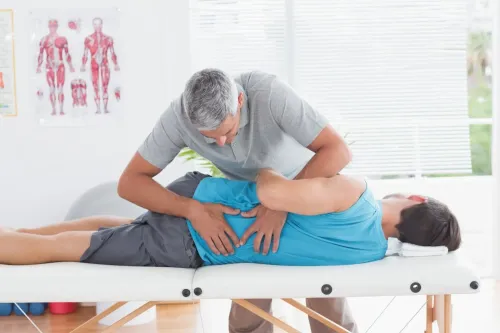
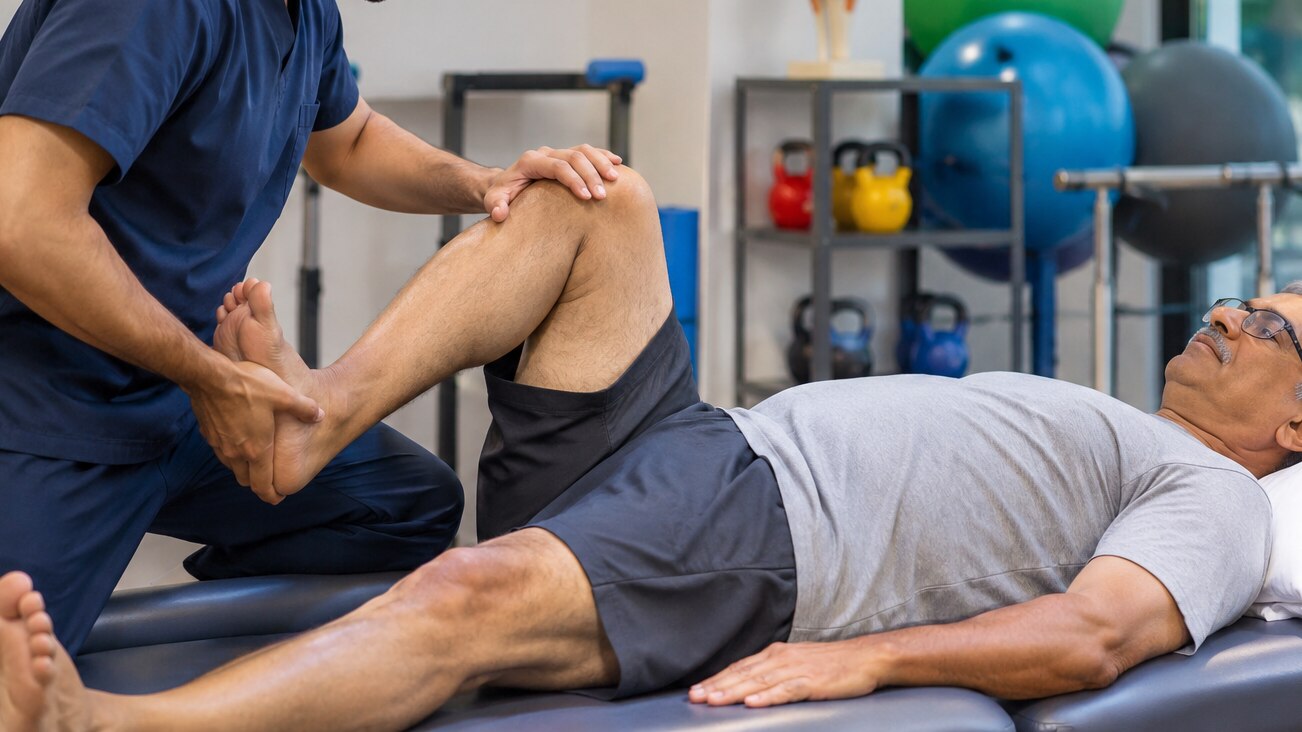
Surgery can leave you starting rehabilitation with weakness, stiffness, poor balance, or low exercise tolerance that developed during months of pain and reduced activity. By assessing your current abilities and following a surgeon-approved programme, you can enter the operation with a measurable baseline, safer movement strategies, and a clearer plan for recovery.
Key takeaways
- Measure strength, mobility, balance, and daily function before choosing exercises.
- Train around the surgical area without provoking lasting pain or swelling.
- Track repetitions, walking tolerance, range of motion, and recovery after exercise.
- Stop and contact your care team for sharp pain, new weakness, or unusual swelling.
What Pre-Surgical Rehabilitation Is—and When It Helps
Pre-surgical rehabilitation is planned treatment before an operation to improve physical capacity, movement, confidence, and recovery skills. Prehabilitation differs from post-surgical physiotherapy, which protects healing tissues and restores function after surgery.
The ordinary fitness training comparison is simple: prehabilitation is tailored to a diagnosis, surgical plan, medical risks, and specific functional deficits, not general exercise goals.
| Approach | Main purpose | Typical focus |
|---|---|---|
| Prehabilitation | Prepare you for surgery | Strength, mobility, fitness, education, breathing, nutrition, or smoking cessation |
| Post-surgical physiotherapy | Support healing after surgery | Protection, range of motion, progressive loading, and return to function |
| Ordinary fitness training | Improve general health or performance | Broad conditioning without surgical restrictions or recovery targets |
Prehabilitation is not one standardized treatment. It may combine resistance and aerobic exercise with breathing work, nutrition support, smoking cessation, education, or psychological support. It commonly supports people preparing for knee or hip replacement, ACL reconstruction, rotator-cuff repair, spinal surgery, and major abdominal or cancer surgery.
For knee and hip replacement, programmes often improve preoperative strength and function, but they do not reliably shorten hospital stays, eliminate post-surgical physiotherapy, or guarantee better long-term outcomes. For ACL injury, practical targets include full knee extension, reduced swelling, quadriceps activation, and better movement control.
Prehabilitation cannot repair every tear or replace surgery when instability or another indication remains.
Do not delay medically indicated surgery to chase an arbitrary strength target. The surgeon’s timing and restrictions take priority.
The Assessment: Measure What Surgery Will Ask You to Do
A useful pre-surgery assessment measures what your operation will ask you to do, not only how much pain you report. It creates a baseline for function and shows whether limited performance reflects the joint, general health, or both.
1. Measure walking tolerance with walking time, distance, or a timed walk. Record gait, balance, swelling, stair ability, and exertional response. For abdominal, thoracic, or major cancer surgery, include breathing capacity and breathlessness during activity.
2. Record joint range of motion in degrees, such as knee extension or shoulder elevation. Complete muscle strength testing through manual testing, repeated movements, a set number of repetitions, or a dynamometer when available. Test sit-to-stand performance over a fixed interval.
3. Ask about task-specific activities: dressing, bathing, carrying, getting out of a chair, and managing stairs. These details reveal limitations that a clinic exercise may miss.
4. Turn findings into repeatable targets: repeat the same timed walk, count sit-to-stand repetitions in the same interval, record tolerated steps or stair flights, and remeasure knee or shoulder range. Use a surgeon-approved strength or movement-control goal rather than an arbitrary number.
There is no universal prehab test. Anemia, poor nutrition, uncontrolled diabetes, frailty, or unusually low exercise tolerance requires communication with the surgical or primary-care team; do not label it poor motivation.
Exercises That Build Capacity Without Irritating the Surgical Area
The diagnosis and surgeon’s precautions decide which pre-surgery exercises are safe. An unstable fracture, unhealed tendon, acute infection, or weight-bearing restriction can make a standard routine harmful.
| Area | Useful capacity-building options | Key boundary |
|---|---|---|
| Knee or hip | Pain-limited sit-to-stands, supported mini-squats, straight-leg raises when appropriate, heel raises, gentle range-of-motion exercises, and walking or cycling | Walk or cycle only if weight-bearing is permitted; stop before form breaks down |
| ACL injury | Quadriceps-setting, controlled knee extension, swelling management, hip and trunk strengthening, and balance work | Do not test instability with twisting, jumping, or heavy loading |
| Shoulder or rotator cuff | Surgeon-approved scapular setting, pendulum exercises, assisted range-of-motion work, and lower-body aerobic conditioning | Avoid heavy overhead loading unless specifically cleared |
| Spinal or abdominal surgery | Walking intervals, posture and functional-movement practice, and prescribed breathing exercises | Follow lifting, bending, and breathing instructions exactly |
Complete the home programme at its prescribed frequency. Start with a load that allows controlled form, then use resistance progression by increasing repetitions, resistance, range, or complexity only when symptoms settle between sessions.
If pain or swelling rises, reduce resistance or range, shorten the session, or switch to a lower-impact option. Contact the clinical team when symptoms persist, or sooner for rapidly increasing swelling, new motion loss, marked instability, chest pain, fainting, unusual breathlessness, or calf swelling.
Timing, Progress Tracking, and Coordination With Your Surgeon
Many prehabilitation studies run for roughly two to eight weeks, but how long prehabilitation takes depends on your operation date, baseline fitness, injury severity, and available medical clearance. A short programme can improve muscle activation, safer transfers, or prevent deconditioning. Do not postpone indicated surgery to reach an arbitrary strength target.
1. Begin with an initial assessment. Record the same baseline measures you will repeat later: timed walking, sit-to-stand repetitions, stair tolerance, joint range in degrees, strength, swelling, balance, gait, and relevant daily tasks.
2. Use supervised visits to learn technique, choose a safe starting load, and understand your home exercise programme. Repeat the prescribed sessions at home, then progress repetitions, resistance, range, or complexity only when symptoms settle between sessions.
3. Reassess using the original measures rather than relying on pain alone. A clinician in Thane, such as N V Physiotherapy clinic - 9076000356, can translate surgical instructions into measurable home targets, but your surgeon’s restrictions take priority.
4. Require physiotherapist and surgeon coordination before changing the plan. Share imaging findings, weight-bearing restrictions, movement limits, an unhealed tendon or fracture, wound problems, anticoagulant use, infection concerns, and the scheduled operation date.
Include smoking cessation in preparation. Stopping at least about four weeks before surgery is more consistently linked with fewer complications than stopping shortly before; stopping at any time is preferable to continuing.
Common Mistakes and Signs to Stop Training
1. Start prehabilitation before the operation is close; waiting leaves less time to improve strength, walking tolerance, and confidence. Common prehabilitation mistakes include training through pain, testing a damaged joint with heavy loads, stopping all movement from fear, and repeating a fixed routine without progressive resistance or reassessment.
Use prescribed pain relief as support, not as your only measure of readiness.
2. Judge surgical readiness by function: walking time or distance, strength, joint range, balance, stair ability, confidence with dressing or getting out of a chair, breathing capacity when relevant, and control of swelling. Expected exercise soreness or a brief symptom increase should settle between sessions.
Exercise warning signs require medical review: rapidly increasing swelling, new loss of motion, marked instability, chest pain, fainting, unusual breathlessness, or calf swelling. Do not push through them.
3. Reduce resistance, range, session length, or impact when symptoms persist, then contact your clinical team. Progress only when you can control the movement and recover between sessions; reassessment should repeat measures such as timed walking, sit-to-stands, stairs, range, and strength.
For abdominal or cancer surgery, do not treat exercise alone as equivalent to multimodal pathways combining exercise, nutrition, smoking cessation, and education; outcomes vary with the operation and your health status. The best programme is progressive enough to build capacity, conservative enough to respect restrictions, and specific enough to measure.
Frequently asked questions
What is pre-surgical rehabilitation?
Pre-surgical rehabilitation is planned treatment before an operation that builds physical capacity, movement, confidence, and recovery skills.
When does pre-surgical rehabilitation help?
It helps when you need better strength, mobility, conditioning, or exercise technique before surgery, provided training fits the surgeon’s restrictions.
What does a pre-surgical rehabilitation assessment measure?
An assessment can measure range of motion, strength, balance, walking tolerance, pain, swelling, and the daily tasks recovery will require.
Which exercises are suitable before surgery?
Suitable exercises build capacity without irritating the surgical area, such as controlled strengthening, mobility work, balance practice, and conditioning selected after assessment.
When should you stop pre-surgical training?
Stop and seek clinical advice for sharp or escalating pain, new weakness, increased swelling, altered sensation, wound concerns, chest pain, or unusual breathlessness.