Pain that appears on stairs is not a diagnosis: the pattern can involve the kneecap, joint surfaces, muscles, meniscus, ligaments, hip or lower back. By the end, you will know which clues support a physiotherapy assessment, which symptoms need medical review first, and how to manage stairs and exercise safely while you arrange care.
Key takeaways
- Pain around the kneecap during stairs often points to patellofemoral pain.
- Seek medical assessment for major swelling, deformity, fever, or inability to bear weight.
- A useful plan tests strength, movement, walking mechanics, pain, and daily function.
- Track stair pain, walking tolerance, swelling, and recovery time each week.
What your walking and stair-pain pattern may indicate
Pain pattern can suggest possibilities, but it cannot diagnose the cause. Knee osteoarthritis often produces knee pain while walking or during other activity, stiffness after rest and gradually reduced movement. Patellofemoral pain commonly sits around or behind the kneecap and worsens with knee pain climbing stairs, squats, running or prolonged sitting.
Stairs demand more knee loading and control than level walking. Pain going up can point toward difficulty producing force or managing kneecap loading; pain going down can expose poor eccentric control, leg alignment or confidence. Neither pattern confirms a condition. Weak quadriceps, hip muscles or calf muscles can reduce control and increase strain.
Meniscus or ligament problems become more concerning after a twist or impact, especially with catching, instability or sudden swelling.
Pain from the hip or lower back can be felt at the knee. Consider that possibility when symptoms spread beyond the knee or include back, buttock or groin pain, numbness or tingling. Note these features before seeking assessment:
- Exact pain location and whether it travels
- Swelling, clicking, catching, locking or giving way
- Stiffness after rest and how long it lasts
- Recent twist, fall, impact or change in activity
- Loss of knee movement, including difficulty fully bending or straightening
Use these observations to describe your symptoms, not to label the condition yourself.
When knee pain needs medical assessment before exercise
If you cannot bear weight, have a visible deformity, a locked knee that cannot fully bend or straighten, sudden calf swelling, or severe calf pain, seek prompt medical assessment.
1. After substantial trauma, especially a fall, twist, or impact, severe pain needs urgent review. Suspected fracture, dislocation, or acute major ligament injury requires a knee injury assessment rather than standalone routine physiotherapy.
2. A hot, red, markedly swollen knee with fever or feeling unwell needs urgent review. Infection, severe inflammatory flare, or another acute inflammatory process must be considered.
3. Arrange orthopaedic or medical evaluation for recurrent giving way, substantial swelling, persistent loss of motion, atypical symptoms, or pain that fails to improve. These findings can change whether knee pain imaging or another investigation is appropriate.
A gradual, activity-related pattern without knee pain red flags is different. Physiotherapy can be a reasonable first step when you can bear weight, the knee is not locked or deformed, and symptoms are not worsening.
Typical patellofemoral pain is usually assessed clinically and does not require routine imaging. Clinical knee osteoarthritis also usually does not need routine imaging, particularly when symptoms fit activity-related pain and brief stiffness after rest. Atypical features, an injury, persistent deterioration, or failure to improve justify reassessment and possible imaging.
What a useful physiotherapy assessment and plan should include
Before accepting a generic list of knee strengthening exercises, expect a knee pain physiotherapy assessment that explains what is driving your symptoms and what you need to regain. A clinician should ask about onset, injury, pain behaviour, swelling, stiffness, medical history, activity demands and goals.
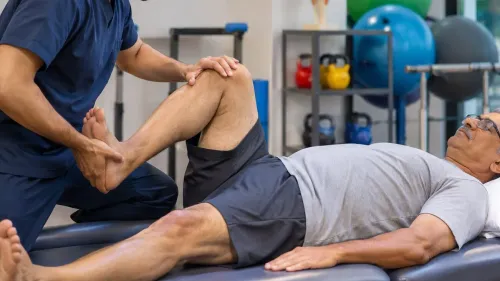
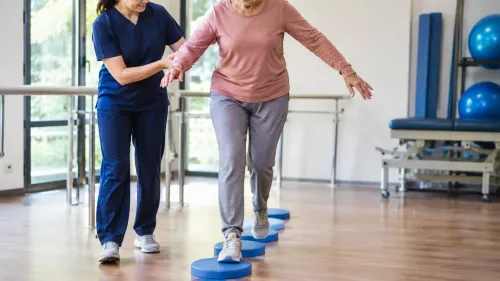
1. Expect observation of walking, knee alignment and movement, followed by stair or sit-to-stand assessment when safe. The examination should include knee range of motion, quadriceps, hip and calf strength, balance, hip movement, and relevant spinal or nerve signs.
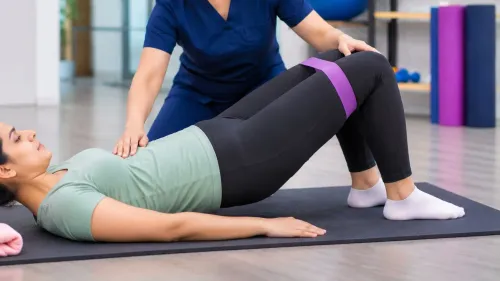
2. Ask how the plan will be progressed. Treatment may include graded quadriceps, gluteal and calf strengthening, mobility work, balance and movement retraining, stair technique, activity modification and a home programme matched to your symptoms and capacity.
3. Ask for the home-exercise frequency, progression rules, review points, escalation criteria and guidance on whether imaging or referral is needed. Muscle effort or mild temporary soreness can occur; sharp or escalating joint pain, increased swelling or sustained loss of function requires reassessment.
For knee osteoarthritis exercise, therapeutic strengthening plus aerobic activity such as walking, cycling or water exercise forms the core approach. For patellofemoral physiotherapy, combined hip- and knee-targeted exercise is more useful than knee exercise alone.
Manual therapy, taping or braces should not replace exercise. Each needs a specific rationale, such as a documented movement problem or instability.
How to decide between physiotherapy, rest, medication and other options
Rest can settle an irritated knee, but physiotherapy or rest for knee pain is not an either-or decision. Prolonged avoidance does not rebuild strength or movement control; stairs can feel harder after your capacity falls.
| Option | Useful role | Limitation |
|---|---|---|
| Rest and activity modification | Settles an irritated knee and reduces flare-ups | Does not restore strength, control or confidence by itself |
| Medication or injection | Reduces pain enough to walk or exercise | Does not replace assessment, progressive exercise or injury investigation |
| Supervised physiotherapy | Matches diagnosis, exercise dosage and progression to your symptoms | Requires repeated home exercises, pacing and review |
| Surgery | Addresses selected structural problems, such as certain major injuries or persistent mechanical problems | Not the default for ordinary activity-related knee pain |
| Online exercises | Offers general ideas | Cannot distinguish knee, hip and back causes or check technique |
Supervised physiotherapy adds value through examination, exercise selection, dosage, feedback and progression. A home exercise programme may include repeated strengthening, mobility or stair practice; returning to stairs too quickly can provoke a flare, while complete rest can reduce capacity.
In Thane, ask N V Physiotherapy clinic - 9076000356 whether the clinician evaluates stair mechanics, checks for hip, back, referral or imaging needs, provides a written home exercise programme, schedules review points and explains when to stop or seek medical care. Expect temporary changes to aggravating activity, gradual progression and reassessment—not a one-session fix.
Pain medication or an injection can support participation, but they are not a substitute for finding why the knee hurts.
Related services
Pain Management Therapy ₹800 At N V Physiotherapy Clinic in Thane, Dr. Nikita Vaidya Kulkarni (PT) offers comprehensive pain management therapy aimed at identifying and treating... View service → |
All Orthopedic Conditions Therapy All Orthopedic Conditions Therapy ₹800 N V Physiotherapy, led by Dr. Nikita Vaidya Kulkarni (PT), offers comprehensive care for a wide range of orthopedic conditions. View service → |
What you can do on the stairs and how to measure progress
Use the handrail and take one step at a time when needed. Put your stronger leg first going up, then your more painful leg first going down. Reduce repeated trips if stairs provoke symptoms. This stair technique for knee pain lowers demand while you build capacity.
Avoid complete inactivity, but do not push through sharp pain, increasing swelling or repeated giving way. Do not buy a brace without checking its purpose and fit; braces are not a substitute for a suitable exercise plan. Look beyond the knee: hip strength, foot position, footwear, body weight and trunk control can change joint loading.
Weight loss can support symptom management for people carrying excess weight; any sustainable reduction may help, and greater loss often brings greater benefit in weight loss and knee osteoarthritis.
Use this knee pain progress tracking routine each week:
- Record walking distance, stair flights, swelling, stiffness and confidence.
- Check strength and knee range of motion using the same simple task or clinician-approved test.
- Note daily tasks that become easier, such as standing, dressing or shopping.
- Compare symptoms the next day, not only during exercise.
Continue an effective programme after symptoms improve, with progression agreed at review. Persistent deterioration, new locking, instability, trauma, inability to bear weight, or red-flag symptoms should change the plan from knee pain self-management to medical assessment.
Frequently asked questions
What can knee pain while walking or climbing stairs indicate?
Pain patterns suggest possibilities rather than diagnosing the cause. Osteoarthritis often causes activity-related pain, stiffness after rest, and reduced movement. Patellofemoral pain commonly occurs around or behind the kneecap and worsens on stairs, squats, running, or after prolonged sitting.
When should knee pain be medically assessed before exercise?
Arrange medical assessment before exercising when you cannot bear weight, the knee looks deformed, swelling appears suddenly after an injury, the joint locks, or you have fever with redness and warmth. Seek urgent care after a major injury or when the calf becomes swollen and painful.
What should a knee pain physiotherapy assessment include?
A useful assessment reviews your pain pattern, injury history, swelling, knee movement, hip and leg strength, balance, walking, stair technique, and daily limitations. The plan should set measurable goals and progress exercises according to symptoms and function.
How can you decide between physiotherapy, rest, medication, and other options?
Relative rest can reduce aggravating activities without stopping all movement. Physiotherapy is useful when pain, weakness, movement limits, or stair difficulty persist. A clinician or pharmacist can advise on medication, while persistent symptoms or warning signs need medical review.
Related services
Trauma (fracture) Rehabilitation Therapy Trauma (fracture) Rehabilitation Therapy ₹800 At N V Physiotherapy Clinic in Thane, Dr. Nikita Vaidya Kulkarni (PT) provides expert trauma (fracture) rehabilitation therapy to support safe and... View service → |
Women's Health Care Therapy ₹800 At N V Physiotherapy Clinic in Thane, Dr. Nikita Vaidya Kulkarni (PT) provides specialized women’s health care therapy tailored to every stage of a... View service → |
Geriatric Rehabilitation Therapy Geriatric Rehabilitation Therapy ₹800 At N V Physiotherapy Clinic in Thane, Dr. Nikita Vaidya Kulkarni (PT) offers specialized geriatric rehabilitation therapy focused on improving... View service → |
Headaches Therapy ₹800 At N V Physiotherapy Clinic in Thane, Dr. Nikita Vaidya Kulkarni (PT) offers specialized headache therapy designed to address the root causes of... View service → |