An older adult can walk safely on a clear, familiar floor yet lose balance while turning, rising from a chair, stepping over an object, or talking outdoors. By the end, you will know what gait training tests, how therapists match exercises and walking aids to the source of instability, and how to make practice safer at home.
Key takeaways
- Train turns, obstacles, balance, and speed—not only straight-line walking.
- Match exercises to shuffling, freezing, foot drop, dizziness, or unsafe turns.
- Set cane and walker height correctly, then practise safe transfers and braking.
- Progress from supported drills to outdoor walking one challenge at a time.
What gait training involves beyond walking in a straight line
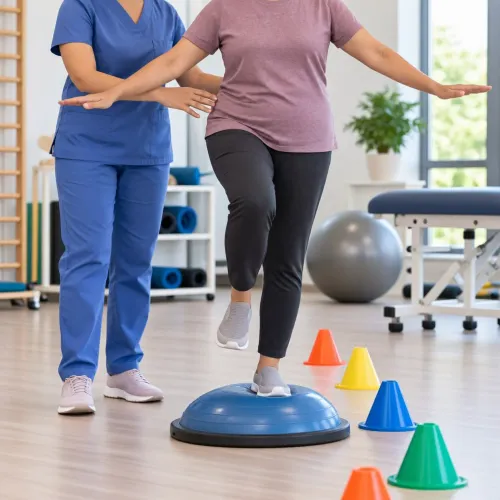
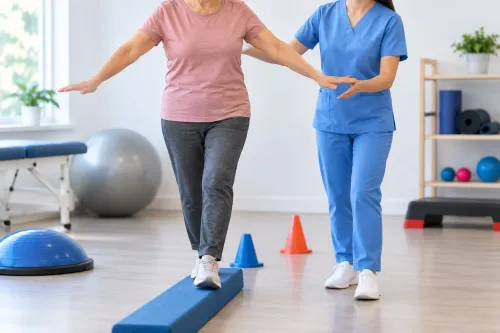
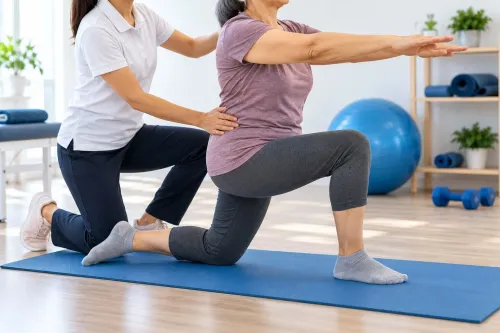
Gait training is targeted practice for the situations that make walking unstable, not repeated laps along a clear corridor. It begins with observing posture, foot clearance, step length, cadence, weight transfer and walking speed, then turns those findings into tasks that challenge balance without creating unnecessary danger.
- Step-length practice to reduce short, shuffling steps and improve foot placement
- Cadence training to control the timing and rhythm of steps
- Weight shifting, narrow-base standing and stepping in different directions
- Starting, stopping, turning, backing up and changing speed
- Stepping over obstacles and around furniture
- Transfers between a chair and standing, including controlled sitting
- Stair practice and walking across grass, slopes or uneven flooring
Ordinary walking practice misses the moments when many falls happen: rising from a chair, turning to answer someone, carrying an object, avoiding an obstacle or stopping suddenly. It also does not reliably challenge the balance reactions, leg strength and divided attention needed for walking stability.
A programme therefore progresses from supported tasks to more demanding ones as control improves.
The dose matters too. Walking for an unspecified amount of time is not the same as fall-prevention exercise. Research links programmes with at least three hours each week of balance-challenging exercise to greater fall reduction than lower-dose programmes, although exercise does not remove all risk.
Practice must match your ability and include rest or supervision when losing balance is possible.
How a physiotherapist finds the cause of unstable walking
The cause is identified by matching the walking pattern with what happens during transfers, turns, obstacles, conversation, and loss of balance—not by speed alone. The physiotherapist observes step length, cadence, foot clearance, joint range, posture, pain, and whether you veer or freeze.
Common questions include:
- Have you fallen, nearly fallen, or started using furniture for support? When and where did it happen?
- Do you feel pain, leg weakness, numb feet, blurred vision, spinning, light-headedness, or a sudden need to sit?
- Does walking worsen in darkness, on uneven ground, during turns, or while talking?
- Did the problem begin after an injury, illness, medication change, or dose increase?
| Possible source | Clues | Assessment or follow-up |
|---|---|---|
| Weakness | Hands needed to rise; knees buckle | Five Times Sit-to-Stand test and strength testing |
| Restricted movement or pain | Short steps, guarded weight-bearing | Joint range and pain assessment |
| Poor foot clearance | Toe catches; foot slaps down | Swing-phase observation and ankle testing |
| Sensory loss or neuropathy | Worse without visual cues; numb feet | Foot sensation, footwear, and balance testing |
| Vision problem | Misjudges steps or obstacles | Vision history and environmental review |
| Dizziness or vestibular problem | Spinning or veering with head movement | Positional symptoms, blood pressure, and vestibular screening |
| Medication effect | Unsteadiness after a new dose | Prescriber-led medication review |
| Neurological condition | Freezing, tremor, marked asymmetry | Neurological screen and referral when indicated |
The Timed Up and Go test examines standing, walking, turning, and sitting. The 10-Metre Walk Test measures usual and fast walking speed; the Berg Balance Scale and Functional Gait Assessment challenge balance in different positions and tasks.
N V Physiotherapy clinic - 9076000356 can use these results to separate a strength problem from a balance, sensory, or neurological problem before selecting exercises.
Related service
Geriatric Rehabilitation Therapy Geriatric Rehabilitation Therapy ₹800 At N V Physiotherapy Clinic in Thane, Dr. Nikita Vaidya Kulkarni (PT) offers specialized geriatric rehabilitation therapy focused on improving... View service → |
How training changes for shuffling, freezing, foot drop, dizziness, and turns
The failed movement determines the practice task. A Functional Gait Assessment helps identify whether difficulty appears during narrow-base walking, speed changes, head turns, obstacles, or pivoting; the programme then repeats that challenge at a safe level rather than prescribing identical walking drills.
- Shuffling: practise larger steps, heel contact, weight transfer and stopping on command; floor markers or rhythmic counting help prevent progressively shorter steps.
- Freezing of gait: use a visual target, metronome beat, rocking weight shifts or a spoken cue to restart; practise doorway approaches and turning instead of forcing a frozen step.
- Veering: train upright alignment, equal loading and walking toward clear visual targets, then add gentle head movements or reduced visual input only under supervision.
- Foot drop: strengthen ankle dorsiflexors, practise toe clearance over low obstacles and assess whether an ankle-foot orthosis or footwear change is needed.
- Knee buckling: build quadriceps and hip strength through sit-to-stand and controlled step-ups, then practise loading one leg; repeated collapse requires clinical review.
- Fear of falling: begin with supported, predictable routes and short bouts, increasing distance, obstacles and independence only after control improves.
- Dizziness: use slow position changes and carefully graded head movement; stop for new severe dizziness, fainting, chest pain or neurological symptoms and seek medical assessment.
- Turns: reduce speed, widen the arc, take several small steps and keep the walking aid positioned correctly; avoid rapid pivoting.
A therapist adjusts repetitions, support and distractions after each attempt. Training should challenge balance without rehearsing panic or repeated near-falls.
How to use a cane, walker, or rollator without adding risk
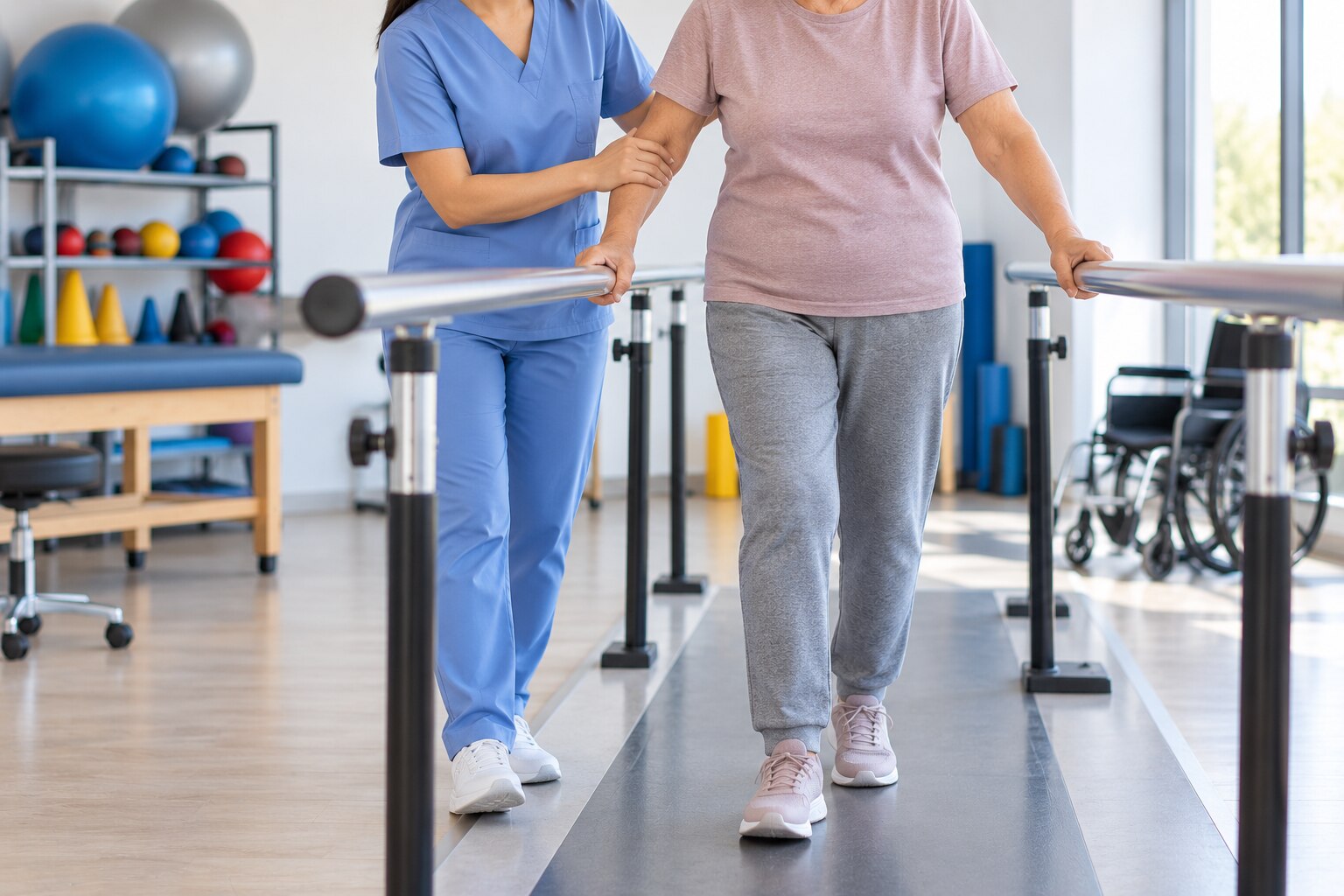
Choose the least-supportive device that gives reliable balance: a cane for one-sided support, a standard walker for maximum stability, or a rollator when you need continuous support with easier movement. A walking aid assessment should also consider hand strength, vision, cognition, pain, stairs, and whether you can operate brakes safely.
| Device | Correct position | Safe technique |
|---|---|---|
| Cane | Handle at wrist crease; elbow bent 15–20 degrees; held opposite the weaker leg | Move the cane and weaker leg together, then step through with the stronger leg |
| Standard walker | Handgrips at wrist crease; shoulders relaxed; elbows slightly bent | Push or lift it a short distance, place all four feet firmly, then step inside its frame |
| Rollator | Handles at wrist crease; body stays between the rear wheels | Release brakes only while moving; apply both brakes before sitting, standing, or using the seat |
Cane placement on stairs matters: step up with the stronger leg first and down with the cane and weaker leg first. Never pull yourself up by a walker or rollator, and do not carry bags in your hands; use a basket that does not obstruct the wheels.
Request reassessment if you stoop, shrug, reach beyond the frame, catch the device on your feet, walk faster than the rollator, or feel more unsteady after receiving it. Pain in your wrists or shoulders, repeated near-falls, brake confusion, new dizziness, or a height that cannot be adjusted safely requires review by a physiotherapist or clinician.
How to progress from supported practice to safer community walking
Progress only when the current task is controlled without grabbing furniture, marked sway, or repeated foot misplacement. A physiotherapist can set the starting level and decide when supervision can reduce.
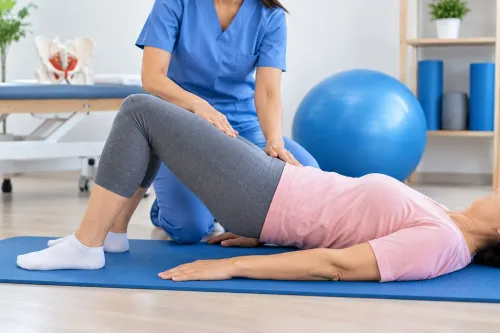
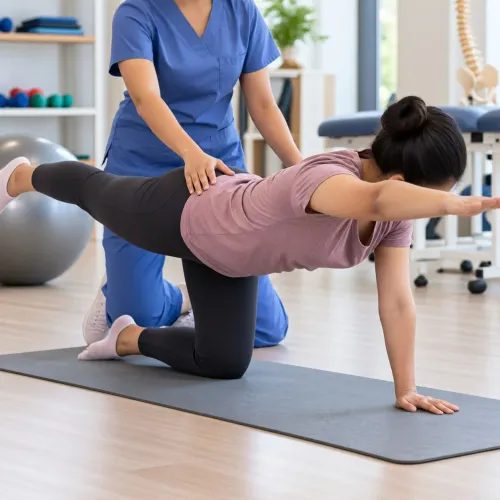
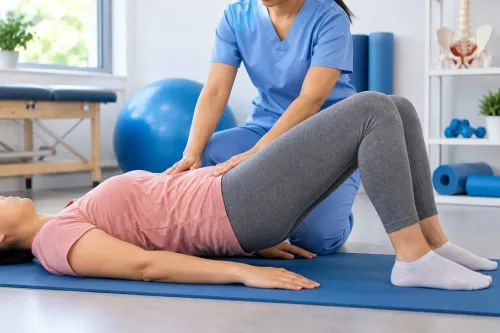
- Begin with supported standing: weight shifts, reaching, heel raises, sit-to-stand, and stepping beside a stable surface. Keep a chair behind you.
- Move to indoor walking on clear, level floors. Practise stopping, starting, turning both ways, and obstacle negotiation with a caregiver nearby.
- Add stairs using the handrail and the prescribed step pattern. Practise uneven ground only after level walking and stairs are reliable.
- Introduce dual-task walking, such as carrying a light cup or answering simple questions. Stop the conversation if gait slows, veering begins, or balance worsens.
- Build community mobility with doorways, kerbs, crowds, lifts, crossings, and short routes before attempting longer or unfamiliar journeys.
Use a written home routine: balance-challenging exercise, lower-limb strengthening, turning, and walking practice on most days. A common fall-prevention target is at least three hours weekly of balance-focused exercise, divided into manageable sessions and adjusted for fatigue, pain, and medical conditions.
Match supervision to risk: hands-on help for stairs or uneven ground, close guarding for new tasks, and independent practice only for familiar tasks.
For fall prevention at home, remove loose rugs and trailing wires, improve lighting, add grab rails where assessed, wear secure footwear, keep the walking aid within reach, and avoid rushing to answer the door or telephone. Reassess after any fall, medication change, dizziness, or decline.
Frequently asked questions
What does gait training involve beyond walking in a straight line?
It practises posture, foot clearance, step length, cadence, weight transfer, turning, obstacles, speed changes, and balance during realistic walking tasks.
How does a physiotherapist find the cause of unstable walking?
A physiotherapist observes walking speed, step pattern, foot clearance, posture, balance, weight transfer, turning, and the situations that trigger instability.
How does gait training change for shuffling, freezing, foot drop, or dizziness?
Training uses different strategies for each problem, such as larger steps for shuffling, cueing for freezing, foot-clearance practice for foot drop, and controlled position changes for dizziness.
How can you use a cane, walker, or rollator without adding risk?
Use the correct device height, keep the aid close, maintain stable contact, avoid pulling up on walkers, and practise turning, sitting, standing, and braking safely.
How do you progress from supported practice to community walking?
Begin with supervised, supported tasks, then add turns, obstacles, varied surfaces, distractions, and outdoor conditions as control and confidence improve.