A fall or near-fall is not always caused by weak legs: dizziness, medication effects, low blood pressure, numb feet, vision loss, joint pain, and neurological disease can all change how safely you move. By the end, you will know which warning signs need urgent care, what an assessment examines, and how rehabilitation progresses from supported practice to safer everyday walking.
Key takeaways
- Seek assessment after one unexplained fall or two falls within 12 months.
- Report near-falls, worsening unsteadiness, and difficulty turning or standing.
- Balance tests help separate strength, vision, inner-ear, and coordination problems.
- Progress from supported exercises to independent walking under clinical guidance.
When Unsteadiness Becomes a Reason to Seek Assessment
An occasional stumble after catching a toe on an obstacle is different from frequent unsteadiness that appears on level ground, during turns, or when standing up. Arrange a clinical assessment after two falls within 12 months, one unexplained fall, repeated near-falls, or balance disorder symptoms that are worsening or changing your daily activities.
| Pattern | What it suggests | Action |
|---|---|---|
| Occasional stumble with an obvious cause and full recovery | A single event rather than an established balance problem | Remove the hazard and monitor |
| Frequent unsteadiness, near-falls, or one unexplained fall | Possible vestibular, vision, medication, blood-pressure, nerve, joint, or strength problem | Book an assessment |
| Frequent falls, injury, fear of walking, or difficulty rising from a chair | Increased risk requiring a structured fall-risk review | Seek assessment promptly |
| Sudden imbalance with neurological or cardiac symptoms | Possible emergency condition | Seek urgent medical care |
Call emergency services for sudden facial drooping, new one-sided weakness, speech difficulty, inability to walk, fainting, chest pain, a sudden severe headache, persistent acute vertigo with neurological symptoms, or a fall causing a head injury. Do not start challenging balance exercises until urgent causes are excluded.
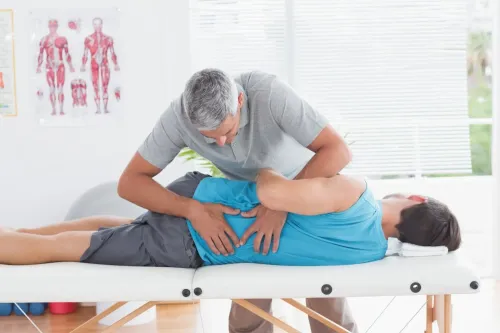
A proper assessment reviews your fall and near-fall history, medicines, vision, footwear, blood pressure after standing, strength, sensation, gait, and home hazards. A single mobility score cannot identify the cause.
What Can Cause Repeated Falls, and What Happens at the First Assessment?
Repeated falls usually have more than one cause. Weakness, joint pain, neuropathy, vestibular disorders, Parkinson’s disease, stroke, post-fracture deconditioning, poor vision, sedating medicines, and unsafe flooring can combine.
Seek urgent medical care after a head injury or with fainting, chest pain, sudden severe headache, facial drooping, one-sided weakness, speech difficulty, inability to walk, or acute vertigo with neurological symptoms.
| Category | Possible cause | What the clinician looks for |
|---|---|---|
| Medical | Weakness, arthritis, stroke, Parkinson’s disease, neuropathy, vestibular disorder | Strength, joint movement, coordination, sensation, eye movements, gait and symptom timing |
| Sensory | Reduced vision, numb feet, impaired inner-ear function | Vision and footwear check, foot sensation, hearing or vestibular symptoms, walking with reduced visual input |
| Medication-related | Sedatives, psychotropic medicines, drugs causing dizziness or low blood pressure | Medication review, recent dose changes, alcohol use and symptoms after each dose |
| Circulatory | Orthostatic hypotension, dehydration, heart-related faintness | Blood pressure and pulse lying down, then after standing; hydration and cardiac symptoms |
| Environmental | Loose rugs, poor lighting, stairs, clutter, unsuitable walking aids | Home hazards, footwear, transfers, stairs and device use |
The first assessment starts with a history of every fall and near-fall: what you were doing, whether you felt dizzy or faint, and whether injury occurred. The clinician observes walking, turning and standing, then checks strength, sensation, coordination and cognition.
Screening tools such as the Timed Up and Go, 30-Second Chair Stand and 4-Stage Balance Test identify risk; they do not diagnose its source. Do not stop a prescribed medicine abruptly; ask the prescriber to change it safely.
What Balance Tests Reveal About the Source of Instability
A Timed Up and Go test measures the time you need to rise from a chair, walk three metres, turn, return, and sit; a slow result flags mobility and fall risk, but does not identify the cause. The 30-Second Chair Stand measures repeated sit-to-stand strength and endurance.
The Berg Balance Scale examines 14 tasks, including transfers, reaching, turning, and standing with reduced support. The four-stage balance test progresses from feet apart to tandem stance.
These are screening tools, not diagnoses. Clinicians combine the scores with your symptoms and physical examination.
- Vestibular dysfunction causes spinning, motion sensitivity, or veering after head movement. Rolling in bed that triggers brief spinning prompts a positional test for benign paroxysmal positional vertigo; a positive result may be treated with an Epley maneuver.
- Weakness appears as difficulty rising, climbing steps, or controlling the knees during walking.
- Poor coordination produces inaccurate foot placement, irregular steps, or trouble with rapid alternating movements.
- Numb feet reduce vibration and position sense, especially in dim light; sensation testing and a Romberg test help expose this pattern.
- Joint pain limits weight-bearing, stride length, or turning because movement hurts.
- Faintness causes weakness, blurred vision, or collapse after standing. Blood pressure and pulse are compared lying down and standing, with hydration and medicines reviewed.
New one-sided weakness, speech trouble, fainting, chest pain, severe headache, or inability to walk requires medical assessment rather than balance exercises.
How Balance Disorder Rehabilitation Builds Safer Movement
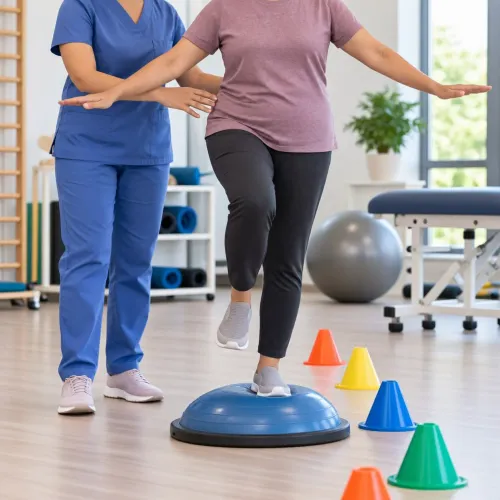
Rehabilitation starts with the task that fails: standing from a chair, turning, stepping over an object, or walking while moving your head. A tailored balance disorder rehabilitation plan combines gait training, lower-limb strengthening, and repeated practice of safe reactions rather than relying on static standing alone.
A session may include:
- Sit-to-stand practice, stepping in different directions, turning, and obstacle negotiation
- Heel raises, hip strengthening, repeated chair rises, and controlled weight shifts
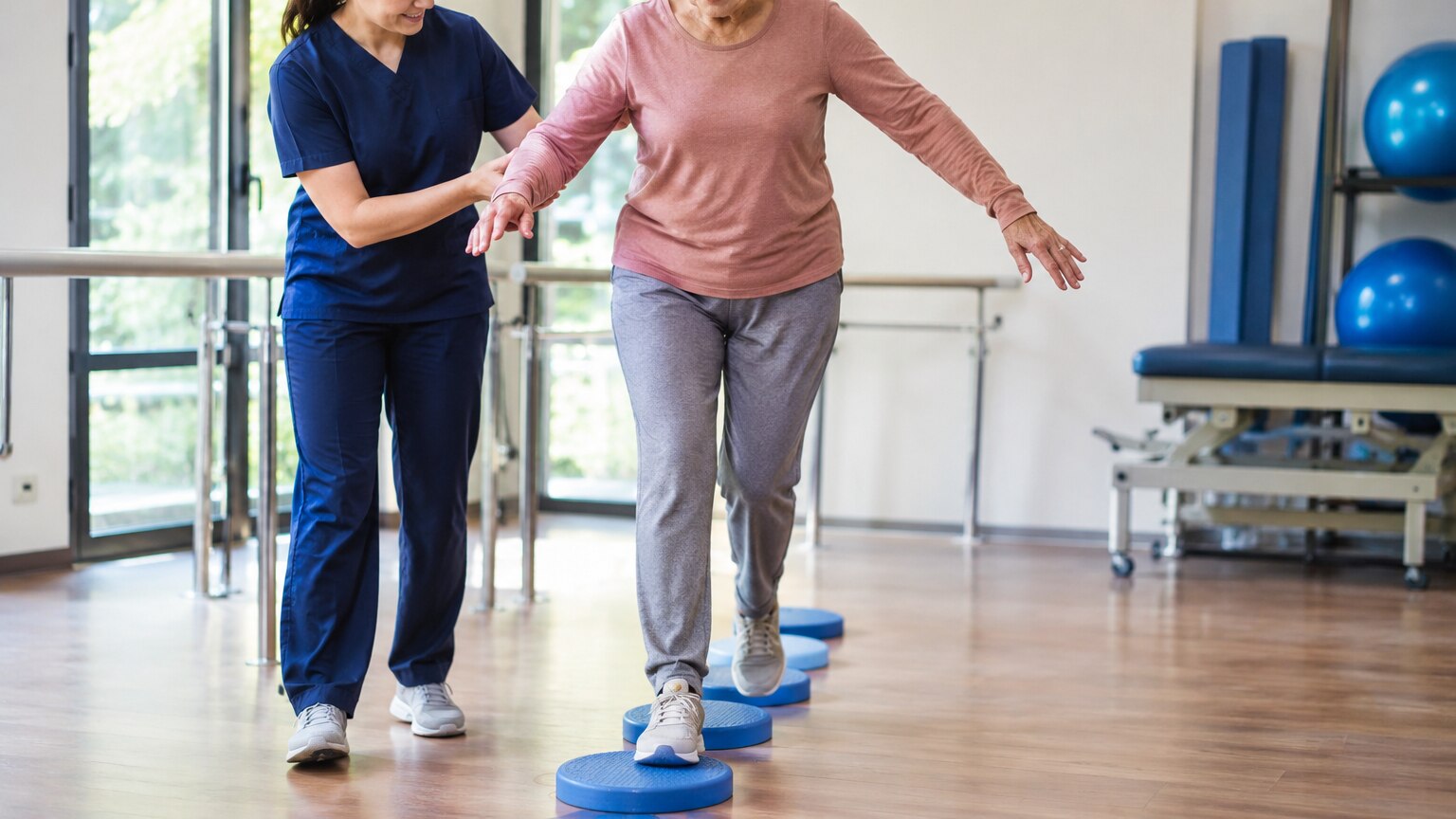
- Walking with reduced hand support, a narrower stance, head turns, altered lighting, or a second simple task
- Instruction in a cane or walker when needed, including correct height and practice on curbs, turns, and transfers
The clinician increases one challenge at a time after you perform the current task safely: less hand support, a smaller base of support, faster direction changes, more visual distraction, or a longer walking distance. Repeating an easy exercise indefinitely will not prepare you for a crowded path or unexpected turn.
Stop and reassess if symptoms persist, technique breaks down, or the task becomes unsafe; home exercises need adjustment for vision, hearing, cognition, strength, and household hazards.
Vestibular treatment depends on the cause. A positive positional test supports BPPV treatment with a canalith-repositioning maneuver such as the Epley maneuver. Peripheral vestibular weakness calls for gaze-stability exercises and graded exposure to head movement or visually busy settings; brief, manageable symptom increases are part of adaptation.
N V Physiotherapy clinic - 9076000356 can help match progression and device use to the specific task that causes instability.
Related service
Geriatric Rehabilitation Therapy Geriatric Rehabilitation Therapy ₹800 At N V Physiotherapy Clinic in Thane, Dr. Nikita Vaidya Kulkarni (PT) offers specialized geriatric rehabilitation therapy focused on improving... View service → |
How to Progress from Supported Practice to Independent Walking
Readiness is task-specific, not a single “good balance” score. You are ready to add a challenge when you can complete the current task without grabbing furniture, losing your line, needing repeated prompts, or experiencing a symptom flare that does not settle quickly.
- Stairs: practise repeated step-ups, controlled step-downs, turns, and rail use without knee buckling or rushing. Progress to a full flight only when you can stop safely and recover balance.
- Outdoor routes: manage uneven ground, curbs, changes in light, head turns, and brief obstacle negotiation while maintaining a steady pace. Begin with a familiar route and a companion.
- Public transport: rehearse standing from a seat, walking to a doorway, turning, and holding a rail before attempting a moving bus or train. Choose quiet periods and sit when available.
- Cane or walker fitting: have a clinician select the device and set its height. Practise the exact problems you face, including curbs, transfers, and tight turns; poor fitting or misuse can create a trip hazard.
Use home balance exercises that include sit-to-stands, stepping in different directions, turning, obstacle practice, and lower-limb strengthening. Reduce hand support gradually rather than repeating an easy routine indefinitely. Address fear of falling with graded exposure: practise one feared task at a safe level, then increase distance, speed, or complexity.
Remove loose rugs, improve lighting, add grab rails, wear secure footwear, and keep walkways clear as part of fall prevention at home. Recheck the programme when dizziness, weakness, vision, hearing, cognition, or the home layout changes.
Frequently asked questions
When should frequent unsteadiness or falls be assessed?
Arrange assessment after one unexplained fall, two falls within 12 months, repeated near-falls, or worsening balance symptoms that affect daily activities.
What can cause repeated falls?
Repeated falls can involve reduced leg strength, vision problems, inner-ear disorders, medication effects, neurological conditions, pain, or difficulty coordinating movement.
What do balance tests reveal?
Balance tests examine strength, walking, turning, standing control, vision, coordination, and inner-ear contributions to identify sources of instability.
How does balance disorder rehabilitation improve stability?
Rehabilitation uses supported balance practice, strength and movement training, walking drills, turning practice, and graded progression toward independent walking.