A parent who struggles with a chair, stairs, or uneven ground needs more than a generic walking plan. By the end, you will be able to screen for a safe starting level, choose practical strengthening and balance exercises, supervise without taking over, and recognise when exercise must stop or receive clinical review.
Key takeaways
- Record chair rises, walking ability, and balance support before exercising.
- Match sit-to-stands, step-ups, and carries to everyday activities.
- Use a stable support and clear walking path during balance practice.
- Stop for chest pain, faintness, new weakness, or unusual breathlessness.
How Do You Choose a Safe Starting Level?
Start with a brief exercise screening for older adults, not a fitness score. During a chair rise test, walking ability check, and simple balance tasks, record what your parent can do and what support they need.
| Check | Record | Starting decision |
|---|---|---|
| Chair rise | Rises from a stable armless chair; note inward-collapsing knees or asymmetry | Use a higher chair, armrests, or hand support if control breaks down |
| Walking | Walks across a clear room and back; note shuffling, slowness, or balance loss | Stay near a counter or chair; make the routine easier |
| Step and balance | Manages one step or stairs; stands with feet together | Provide close supervision when balance is uncertain |
| Grip and support | Holds a light object and describes needing a hand, walking aid, or another person | Arrange individual assessment before progressing |
Repeated loss of balance, marked asymmetry, hands-on assistance, or unsafe stepping calls for a professional fall risk assessment covering gait, balance, medicines, vision, cardiovascular factors, and home hazards.
Do not begin home exercise after a recent fall with injury, unexplained weakness, new numbness, fainting, chest pain, severe shortness of breath, sudden confusion, or sudden speech difficulty. Seek urgent medical care instead.
Arrange broader assessment for recurrent near-falls, major vision or dizziness problems, new weakness, or medicines affecting alertness or blood pressure. Start only beside a stable countertop or chair, never in an open room.
Which Strength Exercises Match Everyday Tasks?
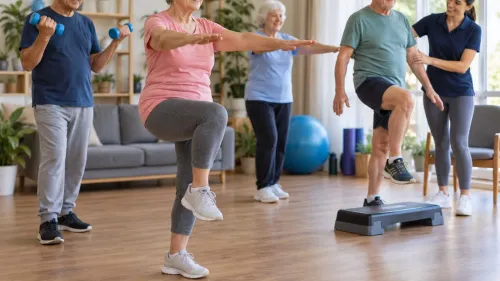
Match each exercise to a task your parent wants to keep doing: sit-to-stands practise transfers, step-ups for parents practise stairs, and wall push-ups support reaching and carrying. Use a stable armless chair and a countertop for support, completing the movements as a circuit.
| Exercise | Everyday task | Key technique |
|---|---|---|
| Sit-to-stand exercise | Rising from a chair or toilet | Place feet under the knees, lean the chest slightly forward, and keep knees tracking with the toes. |
| Supported heel raises | Pushing off during walking | Lightly hold the counter and lift both heels without leaning. |
| Wall push-ups | Reaching and pushing | Keep the body straight and push into the wall without locking the elbows. |
| Step-ups | Climbing a step | Use the lowest secure step and keep the whole foot supported. |
| Standing hip abduction | Side-stepping and stability | Move one leg sideways without tilting the trunk. |
Start with 1–2 sets of 8–12 controlled repetitions. Rest 60–120 seconds between sets and exercises, and use fewer repetitions when technique breaks down.
Make sit-to-stands easier with a higher chair, armrests, or hand support. Progress by using less hand support, lowering the seat, adding repetitions, adding a set, or holding a light weight. Increase resistance only when every repetition stays controlled and pain does not worsen afterward. These movements train useful actions, not isolated muscles alone.
How Can You Train Balance and Walking Without Increasing Fall Risk?
Practise balance exercises beside a counter, not in an open room. Choose a fixed kitchen counter, clear the floor, remove loose rugs and cables, and wear closed-back shoes. Keep both hands available for support, but hold the counter lightly rather than leaning heavily; heavy leaning reduces the balance challenge.
Begin with these drills, in order:
- Shift your weight forward, backward, and side to side while keeping your feet planted.
- Practise tandem stance with one foot partly in front of the other, using the counter as needed.
- Step in different directions, returning to the starting position each time.
- Turn slowly in small steps rather than pivoting quickly.
A parent with high fall risk should not practise difficult standing drills alone. Stop when balance worsens, the feet begin catching, or supervision can no longer keep the person safe.
Add walking intervals on a familiar, well-lit route. Try two minutes of comfortable walking followed by one minute seated or standing rest, then adjust the interval to the person’s ability. Flat walking builds endurance, but it does not challenge balance as much as tandem stance, directional stepping, or turning.
Family supervision for exercise works best when one person gives one clear cue and stays close without blocking the feet. Let the parent initiate, correct, and complete each movement. Never pull an arm, lift under the shoulders, or rush a transfer; available help should not replace the parent’s effort.
How Should You Adapt the Routine for Health Conditions?
Adapt the exercise, range, support, or dose instead of forcing a standard routine. The right change keeps practice useful without turning a manageable movement into a setback.
| Condition | Change the routine | Watch for |
|---|---|---|
| Knee arthritis | For exercise with knee arthritis, use a higher chair, shorter step, and pain-free range. | Reduce the dose if joint pain persists or worsens. |
| Hip pain | Reduce sideways movement and avoid twisting until the cause has been reviewed. | Stop if pain becomes sharp or walking deteriorates. |
| Osteoporosis | Use upright, controlled osteoporosis-safe strengthening. Avoid forceful spinal bending or twisting. | Do not add loaded flexion or rotation without clinical guidance. |
| Diabetes | Check foot sensation, wear suitable footwear, and follow your glucose-management instructions. | Stop for low-blood-sugar signs such as sweating, shaking, confusion, or unusual weakness. |
| High blood pressure | Do not hold your breath or strain. Exhale during effort and rest if symptoms appear. | Seek medical advice for chest pain, faintness, or severe breathlessness. |
| Parkinson’s disease | Parkinson’s exercise may need large deliberate steps, an external rhythm, turning practice, and close supervision. | Increase support when freezing, shuffling, or balance loss appears. |
| Stroke or joint replacement | Use supported symmetrical stroke rehabilitation exercises; do not let the stronger side do all the work. After replacement, follow the surgeon’s restrictions and timeline. | Never copy another person’s post-surgery movements. |
Hold a walking stick opposite the painful or weaker leg. A frame needs individual height and gait fitting. N V Physiotherapy clinic - 9076000356 can assess device use and condition-specific progression in Thane when walking remains unsafe.
Related service
Geriatric Rehabilitation Therapy Geriatric Rehabilitation Therapy ₹800 At N V Physiotherapy Clinic in Thane, Dr. Nikita Vaidya Kulkarni (PT) offers specialized geriatric rehabilitation therapy focused on improving... View service → |
How Do You Progress and Tell Safe Effort from a Warning Sign?
Schedule strengthening at least twice weekly, practise balance on three or more days, and spread walking or another moderate aerobic activity across the week.
The WHO physical activity guidelines target 150–300 minutes of moderate aerobic activity each week for adults aged 65 and over, plus muscle strengthening on at least two days and balance-focused multicomponent activity on at least three days. Limited mobility changes the achievable amount, not the value of balance practice.
Progressive strengthening for older adults means changing one variable at a time. Add two repetitions within the planned range, add a set, reduce hand support, increase a band or weight slightly, or choose a harder variation. Do not add speed before control; fast lifting for power belongs in a supervised programme after technique is reliable.
| Sensation | What it usually means | What to do |
|---|---|---|
| Muscle fatigue | Muscles tire during or soon after work | Rest, then continue at the planned dose |
| Mild soreness | Short-lived training response | Monitor symptoms the next day |
| Joint pain | Pain persists or worsens | Reduce the dose and reassess |
Stop immediately for chest pain, fainting, severe breathlessness, sudden neurological symptoms, or a fall with suspected fracture. Dizziness, unusual weakness, or confusion requires medical advice; these are when to stop exercising.
Keep a simple log of repetitions, support used, walking minutes, symptoms during exercise, and symptoms the next day.
Frequently asked questions
How do you choose a safe starting level for an older adult?
Begin with an exercise screening that records chair rises, walking ability, balance, and the support your parent needs. Start with a level they can complete with controlled movement and no warning symptoms.
Which strength exercises support everyday tasks?
Sit-to-stands support getting up from chairs, step-ups support stairs, heel raises support stepping and walking, and light carries support handling household items.
How can you train balance and walking without increasing fall risk?
Use a stable counter, rail, or sturdy chair for support, clear obstacles from the floor, practise near another person, and progress only when walking remains controlled.
How should exercise be adapted for health conditions?
Adjust the position, range of motion, resistance, repetitions, and rest periods for conditions such as arthritis, osteoporosis, heart disease, dizziness, or recent surgery. Confirm restrictions with the treating clinician.
How can you tell safe effort from a warning sign?
Muscle effort and mild fatigue can be acceptable, but stop and seek medical guidance for chest pain, faintness, new weakness, severe breathlessness, sharp pain, or loss of balance.