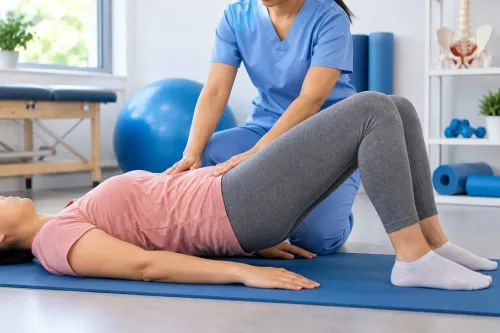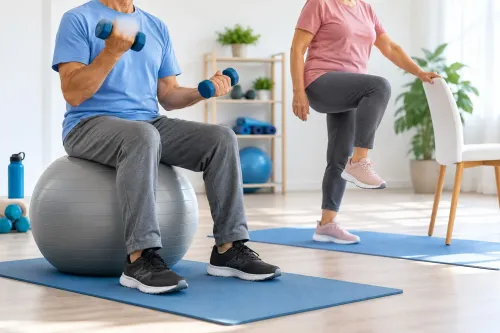
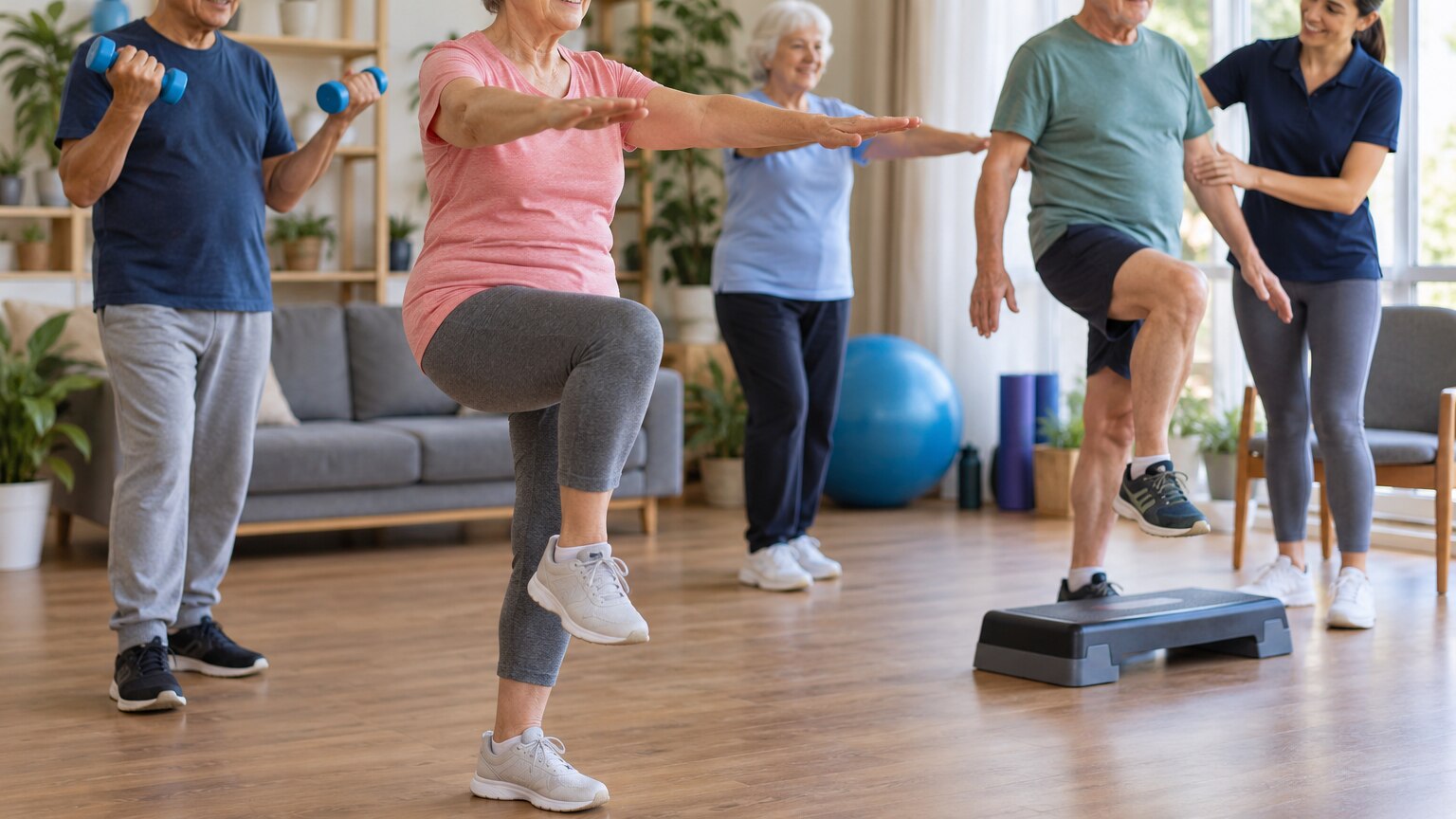
A safe home routine must do more than keep you moving: it must strengthen the muscles used for standing, stepping, and carrying while challenging balance without creating a fall. By the end, you will have a practical sequence, clear progression rules, safety checks, and modification options for common limitations.
Key takeaways
- Get a fall-risk assessment after a fall, dizziness, or new weakness.
- Clear obstacles and exercise beside a sturdy chair or countertop.
- Use strength, balance, walking, and stretching across the week.
- Stop and seek guidance for pain, dizziness, or worsening unsteadiness.
Check Your Risk and Prepare a Safe Exercise Space
Check an older adult’s fall risk before starting balance or strength exercises at home. A previous fall, unsteady walking, difficulty rising, fear of falling, dizziness, or a new change in strength calls for a fall risk assessment rather than a copied exercise sheet.
Ask a clinician to review gait and balance, leg strength, vision, medicines, blood pressure when lying and standing, footwear, and hazards around the home.
1. Choose a clear area away from rugs, cords, pets, wet flooring, and low furniture. Leave enough space to turn without stepping around objects.
2. Improve lighting, including the route to the bathroom. Wear closed, nonslip shoes; avoid loose slippers and exercising in socks on smooth floors.
3. Place the exercise area beside a sturdy kitchen counter, fixed rail, or stable chair for exercise. Do not use a lightweight chair that slides, rolls, or tips when pulled.
4. Keep a phone within reach and arrange supervision for anyone with poor balance, a recent fall, or trouble walking. Begin beside the support, not in the centre of the room.
Slow movement is not automatically safe: one-leg standing, tandem walking, turning, and stepping over objects can still trigger a fall. Stop for sharp pain, dizziness, chest pain, unusual breathlessness, sudden weakness, or new confusion; seek urgent medical help for severe or sudden symptoms.
These precautions form the foundation of home exercise safety and older adult exercise safety.
Build Leg and Core Strength for Everyday Movements
Use a heavy, non-wheeled chair beside a kitchen counter, wear nonslip shoes, and keep your trunk tall rather than pulling yourself up with your arms.
1. Chair sit-to-stands: Sit near the chair’s front edge, feet hip-width apart and slightly behind your knees. Lean your chest forward, press through your feet, and stand without holding the chair; reach back slowly and sit. Start with 1 set of 5 repetitions, using armrests if needed.
2. Supported heel raises: Hold the counter lightly, stand tall, and lift both heels for two seconds before lowering them slowly. Keep your weight over the first and second toes. Begin with 8 to 10 repetitions, then progress to 2 sets or single-leg raises only when balance remains steady.
3. Mini-squats for seniors: Hold a stable surface, send your hips back, and bend your knees a small amount while keeping your knees aligned with your toes. Return to standing and gently tighten your abdomen. Perform 8 to 10 repetitions without letting your heels lift.
4. Step-ups for older adults: Use the bottom stair or a low, firmly secured step with a railing. Place one whole foot on the step, rise through that leg, then step down slowly; alternate legs. Start with 5 repetitions per side and increase height or repetitions only after controlled practice.
Rest 60 to 90 seconds between sets. When the final repetitions feel easy, add two repetitions, reduce arm support, or use a light resistance band. Stop for sharp pain, dizziness, chest pain, unusual breathlessness, or sudden weakness.
Add Balance Exercises Without Removing the Challenge
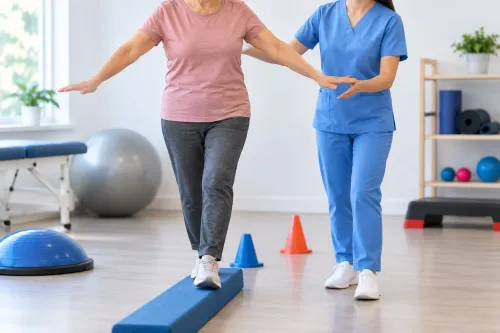
Practise balance exercises for seniors beside a stable kitchen counter or heavy chair, with nonslip footwear, clear flooring, and good lighting. Keep one or both hands on the support until you can complete the movement without gripping tightly; arrange supervision if you have fallen, feel unsteady, or fear falling.
- Weight-shifting exercises: Stand with feet hip-width apart and knees relaxed. Move your body weight slowly towards the right foot, return to centre, then shift left. Repeat 5 to 10 times each way without lifting your feet.
- Marching in place: Hold the support, lift one foot a few centimetres, lower it, and alternate sides. Begin with 10 controlled lifts, keeping your trunk upright; stop if your foot catches or your knees buckle.
- Tandem stance: Place one foot directly in front of the other, heel touching toes, and hold for 10 to 20 seconds. Switch the leading foot, then widen the gap if you sway excessively.
Make the challenge harder one change at a time: use lighter fingertip contact, narrow your stance, increase the hold by five seconds, or add controlled side steps. Do not progress to eyes closed, one-leg standing, head turns, or tandem walking without professional guidance if your balance is poor.
Stop for sharp pain, dizziness, chest pain, unusual breathlessness, or sudden weakness; muscle effort and mild tiredness are acceptable.
Combine Strength, Balance, Walking, and Stretching in a Weekly Plan
A weekly exercise plan for seniors should combine aerobic activity, strength training, balance practice, and stretching rather than rely on walking alone. Walking can provide aerobic activity when it raises your breathing to a moderate level, but walking-only programmes do not consistently prevent falls.
| Activity | Main purpose | How to use it |
|---|---|---|
| Balance training | Control your body while standing, turning, or stepping | Practise several days weekly with support nearby |
| Strength training | Make transfers, stairs, and lifting easier | Train major muscle groups twice weekly |
| Walking | Build endurance and practise steady steps | Use as aerobic exercise if intensity is moderate |
| Other aerobic activity | Raise heart and breathing rates safely | Try cycling, water exercise, or dancing |
| Stretching | Maintain comfortable joint movement | Stretch gently after warm-up or exercise; do not bounce |
A practical weekly exercise plan for seniors can follow this pattern:
- Monday: strength training, followed by gentle stretching.
- Tuesday: 20 to 30 minutes of moderate walking and balance exercises such as weight shifts or marching.
- Wednesday: shorter walking or another aerobic activity, plus stretching.
- Thursday: strength training and balance practice.
- Friday: moderate walking, building toward the 150 minutes moderate activity weekly target.
- Saturday: balance practice and easy aerobic activity.
- Sunday: rest, gentle movement, or stretching.
Keep strength sessions separated by about a day. Make balance harder by reducing hand support or narrowing your stance only when control remains steady. Stretching should feel mild, not sharp; it improves movement but does not replace strength or fall prevention exercise. Begin with smaller amounts if 150 minutes feels unrealistic, then add time gradually.
Modify the Routine and Know When to Seek Professional Guidance
Change an exercise when pain alters your movement, causes limping, or lasts beyond the session. For exercise modifications for knee pain, reduce the squat depth, slow the descent, and use a higher chair; stop if pain is sharp, swelling appears, or the knee gives way. Muscle effort is acceptable; worsening joint pain is not.
Use exercise with a walker or cane when the aid is correctly fitted and prescribed for you. Keep the walker or cane within reach, avoid pulling up on it to stand, and ask a professional to check your hand position and walking pattern.
If standing tolerance is limited, perform marching, heel raises, or knee extensions while seated, then add short standing intervals with rest.
Stop immediately and seek medical assessment for:
- Chest pain, fainting, new severe shortness of breath, sudden weakness, facial drooping, speech trouble, or severe persistent pain.
- Dizziness during exercise, new unsteadiness, or repeated loss of balance. Do not simply reduce repetitions; medication effects, blood-pressure changes, heart problems, or neurological conditions need review.
- A fall, knee giving way, or sudden change in walking ability.
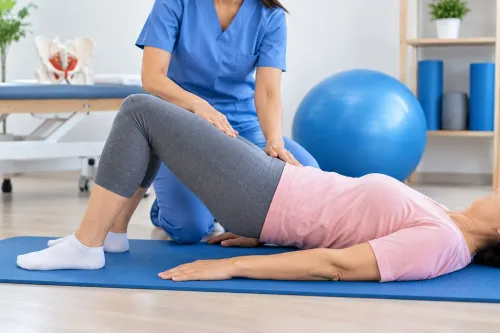
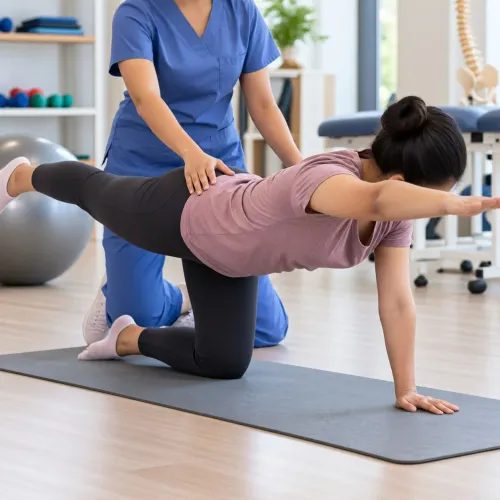
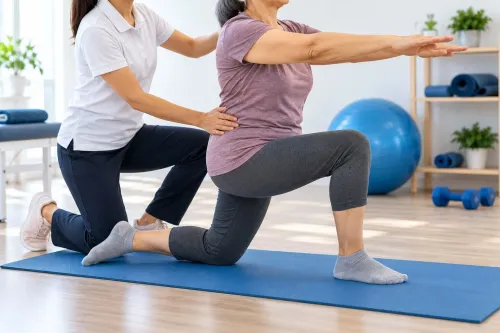
Arrange medical or physiotherapy clearance before starting or progressing a demanding routine after a recent fracture, surgery, heart or lung problem, stroke, unexplained faint, or major fall. A previous fall, fear of falling, poor vision, multiple medicines, or difficulty walking also warrants a gait, balance, blood-pressure, footwear, and home-hazard assessment.
N V Physiotherapy clinic - 9076000356 can help tailor progression when generic exercises are no longer safe.
Related service
Geriatric Rehabilitation Therapy Geriatric Rehabilitation Therapy ₹800 At N V Physiotherapy Clinic in Thane, Dr. Nikita Vaidya Kulkarni (PT) offers specialized geriatric rehabilitation therapy focused on improving... View service → |
Frequently asked questions
When should an older adult get a fall-risk assessment?
Arrange an assessment after a fall, unsteady walking, difficulty rising, fear of falling, dizziness, or a new change in strength.
How can you make a home exercise space safer?
Remove trip hazards and exercise beside a sturdy chair or countertop that you can hold for support.
Which exercise types support daily function?
Combine leg and core strengthening with balance exercises, walking, and stretching to support everyday movements.
When should an older adult seek professional exercise guidance?
Seek guidance when exercises cause pain, dizziness, worsening unsteadiness, or a new change in strength.